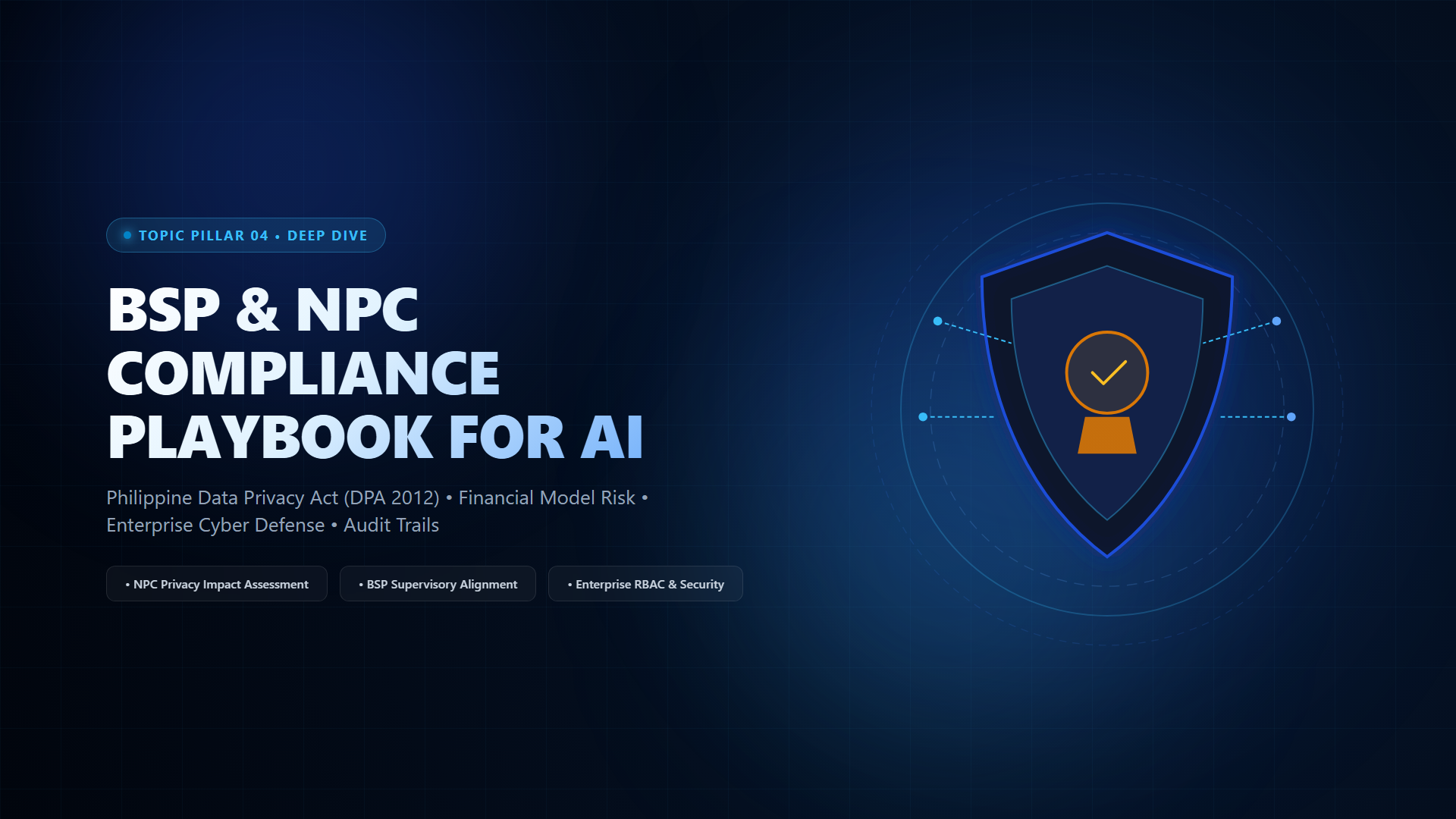
In the digital economy, innovation without institutional trust is an existential liability. In the Philippines, the regulatory environment surrounding artificial intelligence has matured rapidly from theoretical ethics into concrete supervisory enforcement.
The National Privacy Commission (NPC) continues to mandate strict compliance with the Data Privacy Act of 2012 (DPA 2012), applying data protection, consent, and purpose-specification obligations to all automated processing systems. Simultaneously, the Bangko Sentral ng Pilipinas (BSP) has established clear expectations for Supervised Financial Institutions (BSFIs), demanding rigorous model risk management, algorithmic fairness, and non-delegable board oversight.
This comprehensive guide details what comes under the Governed, Secure & Trusted AI pillar—delivering a definitive compliance, risk management, and cybersecurity playbook for Philippine enterprise leaders.
1. The Regulatory Twin-Pillars: NPC DPA 2012 and BSP Supervision
| Regulatory Authority | Key Regulatory Mandates for AI Systems | Operational Impact on Enterprise Deployment |
|---|---|---|
| National Privacy Commission (NPC) - Data Privacy Act of 2012 | Transparency; explicit purpose limitation; data minimization; mandatory Privacy Impact Assessments (PIA); recognition of data subject rights (right to object, correct, and access automated profiling). | Enterprises must ensure that personal data fed into AI models is lawful, auditable, and scrubbed of identifiable elements. Third-party vendor models cannot use corporate data to train public foundation weights. |
| Bangko Sentral ng Pilipinas (BSP) - Model Risk & Technology Guidelines | Proportionate AI governance; explainability of automated decisions (especially in credit scoring and loan origination); algorithmic bias testing; robust disaster recovery and model fail-safes. | Financial institutions must avoid "black box" models for consumer credit decisions. Board-approved governance policies and human escalation pathways are strictly audited during supervisory reviews. |
2. Defending the New Attack Surface: AI-Specific Cybersecurity
Generative AI introduces attack vectors that traditional perimeter firewalls and endpoint protection are entirely unequipped to detect:
- Direct and Indirect Prompt Injection: Attackers embed adversarial instructions within input prompts or within external documents (such as uploaded customer PDFs) to hijack the model's logic and exfiltrate confidential enterprise records.
- Data Poisoning and Training Drift: Compromising knowledge databases or vector indexes to skew outputs, corrupt retrieval, or embed malicious backdoors.
- Sensitive Data Inadvertent Disclosure: Internal users pasting sensitive corporate financial projections, customer records, or source code into unmonitored consumer AI platforms (Shadow AI).
Securing the enterprise requires implementing an AI Gateway Layer : an intelligent proxy between users/systems and models that enforces real-time semantic guardrails, automated PII redaction, prompt injection filtering, and comprehensive cryptographic audit logging.
3. Operationalizing an Enterprise AI Governance Board
Governance cannot remain a theoretical document written by external consultants. High-performing Philippine organizations establish a cross-functional AI Governance & Ethics Committee meeting bi-weekly, composed of:
- The Chief Information Security Officer (CISO): Oversees threat modeling, vulnerability testing, and secure API integration.
- The Data Protection Officer (DPO): Validates NPC privacy compliance, data minimization, and PIA sign-offs.
- Chief Legal & Risk Counsel: Assesses contractual liability, IP rights, copyright exposure, and regulatory reporting obligations.
- Business Unit Leaders: Own the commercial value proposition, operational KPIs, and end-user accountability.
Lead the Conversation on Responsible Enterprise AI
Governed, Secure & Trusted AI is Pillar 04 at World AI Show Philippines 2027 (2–3 March 2027, Manila). Join key policymakers, chief risk officers, CISOs, and legal luminaries driving sovereign and secure AI frameworks.