In the rush to deploy artificial intelligence, many enterprise technology leaders have learned an expensive truth: models do not fail in production; data foundations do.
An advanced foundation model cannot compensate for fragmented legacy databases, stale customer records, unindexed PDF repositories, or disjointed core systems. In the Philippines, where major conglomerates, universal banks, and retail giants have accumulated decades of operational data across disparate silos, bridging the gap between raw data and AI consumption is the definitive engineering battleground of 2027.
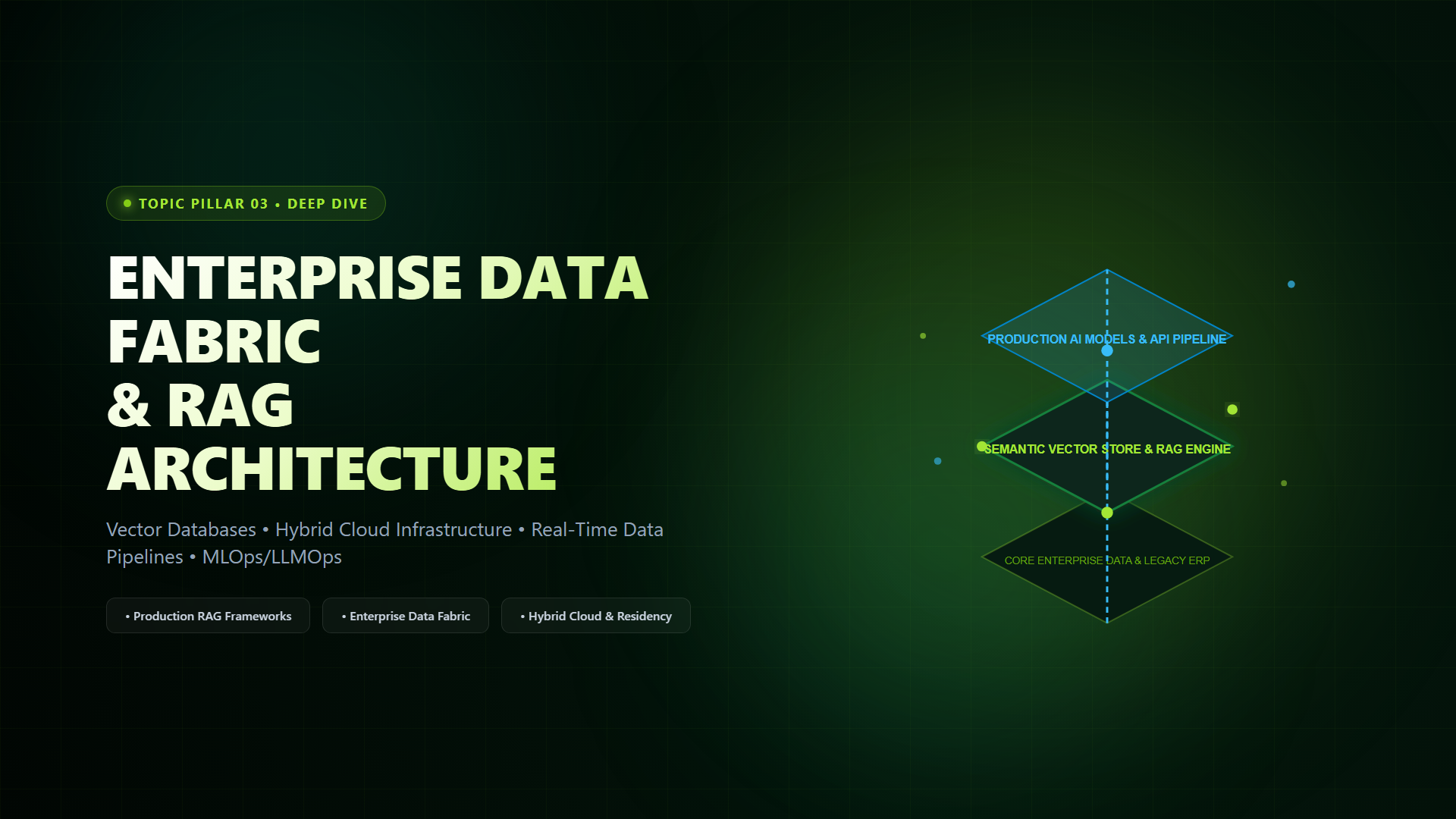
This article explores what comes under the Data & Cloud pillar—outlining the architectural blueprint required to build an AI-ready enterprise data estate.
1. The Evolution from Data Warehouses to AI Data Fabrics
For analytics and business intelligence, data warehouses and standard data lakes were sufficient. For real-time, context-aware AI, enterprises require an AI Data Fabric capable of serving both structured tabular data and unstructured enterprise knowledge:
- Unstructured Data Liberation: Up to 85% of valuable enterprise knowledge in Philippine companies exists in unstructured formats: policy PDFs, customer service transcripts, emails, scanned contracts, and internal chat threads. An AI data engine continuously ingests, cleans, chunks, and indexes this content in real time.
- Real-Time Semantic Vector Stores: Rather than relying solely on keyword matching, vector databases store numerical representations (embeddings) of enterprise knowledge, enabling models to retrieve information based on conceptual meaning, intent, and contextual relevance.
- Unified Metadata & Data Lineage: Every data point retrieved by an AI system must trace back to an auditable source of truth, satisfying both technical observability and regulatory compliance requirements.
2. Advanced RAG (Retrieval-Augmented Generation) in Production
Basic "naive" RAG systems suffer from high hallucination rates and poor context retrieval when confronted with thousands of complex corporate documents. Scaled enterprise deployments in 2027 utilize Production-Grade Advanced RAG Architectures :
- Hybrid Search (Dense + Sparse): Combines vector semantic search (dense retrieval) with traditional BM25 keyword search (sparse retrieval) to ensure that exact policy numbers, product codes, and legal terms are captured alongside semantic intent.
- Contextual Re-Ranking: Raw retrieval passes through a secondary neural re-ranker that evaluates the most relevant chunks before passing them into the model's context window, minimizing token bloat and latency.
- Agentic RAG: If initial retrieval yields conflicting or insufficient information, an autonomous retrieval agent refines its search query, checks alternative data repositories, and self-evaluates factual grounding prior to generation.
3. Hybrid Cloud Infrastructure & Philippine Data Residency
The infrastructure layer must balance compute power against strict compliance realities. Under National Privacy Commission (NPC) frameworks and Bangko Sentral ng Pilipinas (BSP) supervisory guidelines, sensitive personal and financial data requires stringent controls.
Leading organizations are establishing Hybrid AI Topologies : sensitive customer financial data and core inference pipelines remain within sovereign local private clouds or on-premise high-density clusters, while non-sensitive workloads, heavy training runs, and external customer-facing services scale dynamically into global public hyperscalers.
Modernize Your Enterprise AI Foundations
Data, Cloud & the AI-Ready Enterprise is Pillar 03 at World AI Show Philippines 2027 (2–3 March 2027, Manila). Meet top data platform architects, cloud infrastructure providers, and engineering leaders shaping modern enterprise stacks.