Across Philippine boardrooms, the question surrounding artificial intelligence has pivoted abruptly. The conversation in 2024 and 2025 centered on experimentation: "What can these foundation models do?" Entering 2027, CFOs and Chief Digital Officers are asking a far more demanding commercial question: "What is the exact financial and operational return on our AI capital allocation?"
With the Philippine digital economy expanding to PHP 2.74 trillion (9.8% of national GDP, according to the Philippine Statistics Authority), digital maturity has reached a threshold where enterprise technology investments must compete on rigorous unit economics. AI initiatives can no longer survive as R&D vanity projects. They must deliver quantifiable cycle-time compression, customer acquisition efficiency, fraud reduction, or measurable revenue expansion.
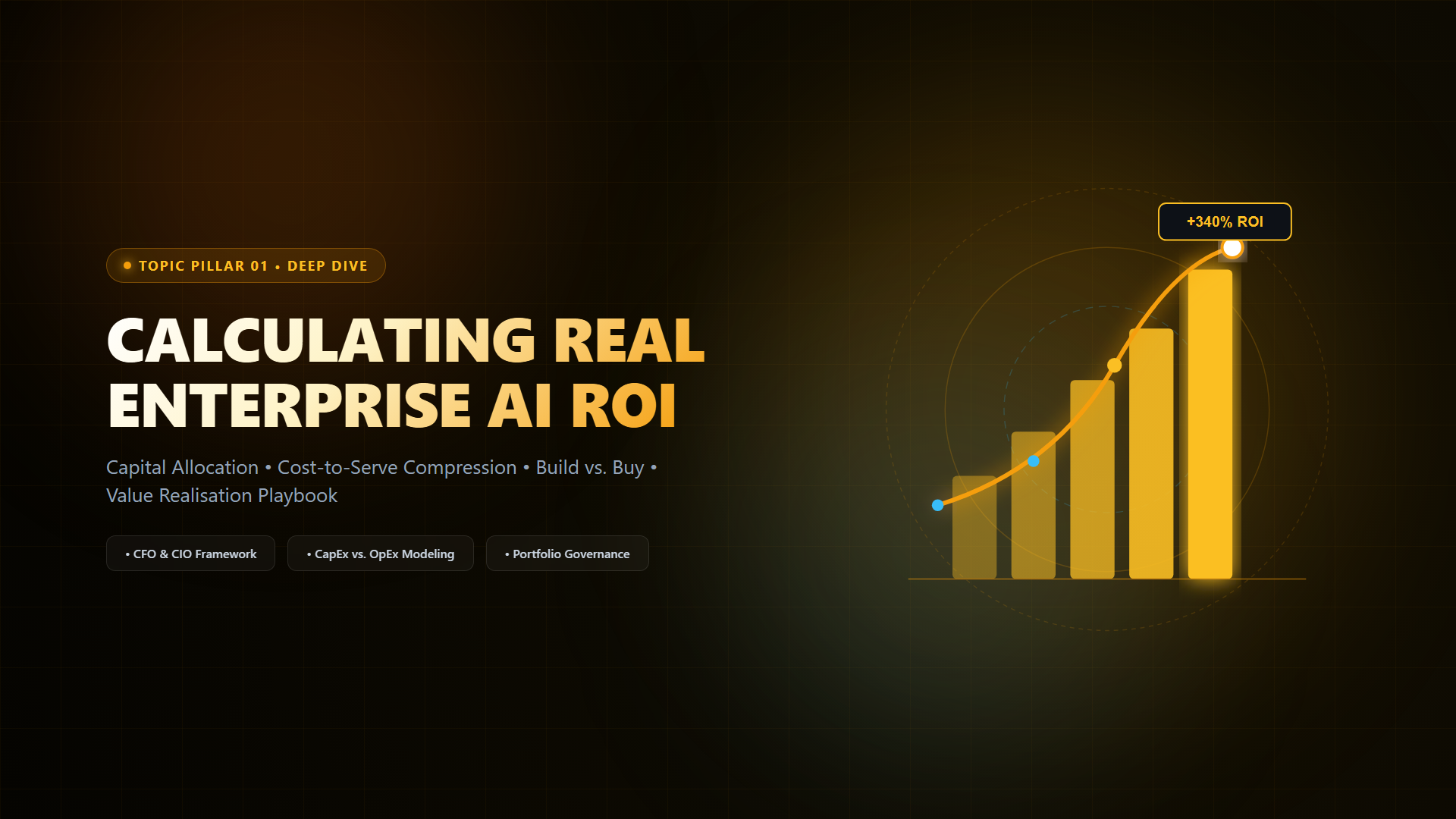
This deep dive examines what falls under the AI Economics & Scale pillar—providing finance, tech, and transformation executives with an actionable framework to fund, govern, and extract audited enterprise value from AI.
1. Deconstructing the AI Capital Stack: CapEx vs. Recurring OpEx
Traditional software investments follow predictable capital expenditure (CapEx) schedules: a major upfront license, implementation costs, and stable annual maintenance fees. Scaled AI introduces a fundamentally dynamic operating expense (OpEx) profile driven by token consumption, compute latency, vector storage, and continuous model retraining.
Philippine enterprises that miscalculate this dynamic risk hitting "cloud sticker shock" as user adoption scales. A robust AI financial model accounts for four core cost tiers:
- Inference and Token Economics: The cost per transaction. A customer service bot answering 500,000 queries per month with a 32k context window creates a recurring variable expense that must be benchmarked against human agent cost-per-contact.
- Data Pipeline and RAG Infrastructure: The compute and storage required to clean, embed, index, and retrieve enterprise data into vector databases.
- Governance, Security, and Auditing: The operational cost of continuous monitoring, red-teaming, guardrails, and compliance audits required by regulatory authorities.
- Human-in-the-Loop Validation: The cost of human specialists reviewing low-confidence outputs, particularly in high-stakes banking and medical domains.
2. The AI Value Prioritization Matrix
Enterprises that scale successfully do not attempt 30 concurrent pilots. They construct a Value vs. Feasibility Portfolio Matrix to allocate capital strictly across three horizons:
| Horizon | Primary Objective | Typical Philippine Use Cases | Expected Payback Window |
|---|---|---|---|
| Horizon 1: Efficiency Engines | Immediate cost-to-serve reduction; manual hour recapture | Internal document search, IT helpdesk automation, KYC document verification in banks | 3 to 6 months |
| Horizon 2: Process Transformation | Structural workflow acceleration; customer retention | Algorithmic credit underwriting, automated claims adjudication, predictive telco churn intervention | 6 to 12 months |
| Horizon 3: Revenue & New Models | Direct commercial top-line growth; competitive moat | Hyper-personalized financial products, autonomous supply-chain logistics routing | 12 to 24 months |
3. The Build vs. Buy vs. Partner Decision Framework
One of the most consequential economic decisions Philippine leadership teams face is deciding where to position their organization on the technology stack:
- Buy (Commoditized Capability): For generalized tasks like email drafting, basic transcription, or routine employee assistance, buying off-the-shelf enterprise SaaS (with enterprise data privacy guarantees) is virtually always more cost-effective than building.
- Partner (Specialized Vertical Systems): In complex domains such as anti-money laundering (AML) detection, Philippine tax compliance, or dialect-specific speech models (Tagalog/Cebuano), partnering with established specialized AI providers dramatically reduces time-to-value while spreading R&D costs.
- Build (Proprietary Differentiators): Reserve internal engineering and custom model fine-tuning strictly for your organization's core intellectual property—such as proprietary credit risk models for unbanked populations or unique logistics routing logic across the archipelago.
4. Establishing AI Portfolio Governance & Stage-Gates
To eliminate "Proof-of-Concept Paralysis," where dozens of prototypes linger without commercial graduation, enterprises must introduce formal stage-gate criteria. Every initiative must meet predetermined hurdle rates before unlocking subsequent funding tranches:
- Gate 1 (Discovery to POC): Validated business problem with an agreed financial metric baseline (e.g., reduce handling time from 8 minutes to 3 minutes). Funding: USD 25k–50k equivalent.
- Gate 2 (POC to Limited Production): Model reaches required accuracy and latency benchmarks on production-grade data with zero critical security vulnerabilities. Funding: USD 100k–250k.
- Gate 3 (Enterprise Scale): Positive unit economics verified in live production with auditable ROI confirmed by internal finance teams. Full enterprise rollout authorized.
Discuss AI Economics & Capital Allocation in Manila
AI Economics, Strategy & Scale is Pillar 01 at World AI Show Philippines 2027 (2–3 March 2027, Manila). Connect with over 300 pre-qualified C-suite decision-makers, CFOs, and tech leaders addressing the commercial reality of enterprise AI deployment.