For the past two years, enterprise generative AI in Southeast Asia was largely synonymous with one interface: the conversational chat window. Organizations deployed internal Q&A assistants, customer service chatbots, and code-completion tools. While these provided incremental productivity boosts, they revealed a fundamental limitation: chatbots can talk about work, but they cannot perform multi-step work autonomously.
Entering 2027, the enterprise paradigm has decisively shifted from conversational interfaces to autonomous agentic workflows . Instead of merely predicting the next word in a chat box, AI agents evaluate complex goals, plan intermediate steps, invoke external software tools via APIs, verify their own outputs, and adapt when encountering errors.
For the Philippines—home to the world's premier IT-BPM industry and a massive digital services sector—agentic AI represents the most profound operational transformation since the inception of business process outsourcing.
1. The Four Architectural Pillars of an Enterprise AI Agent
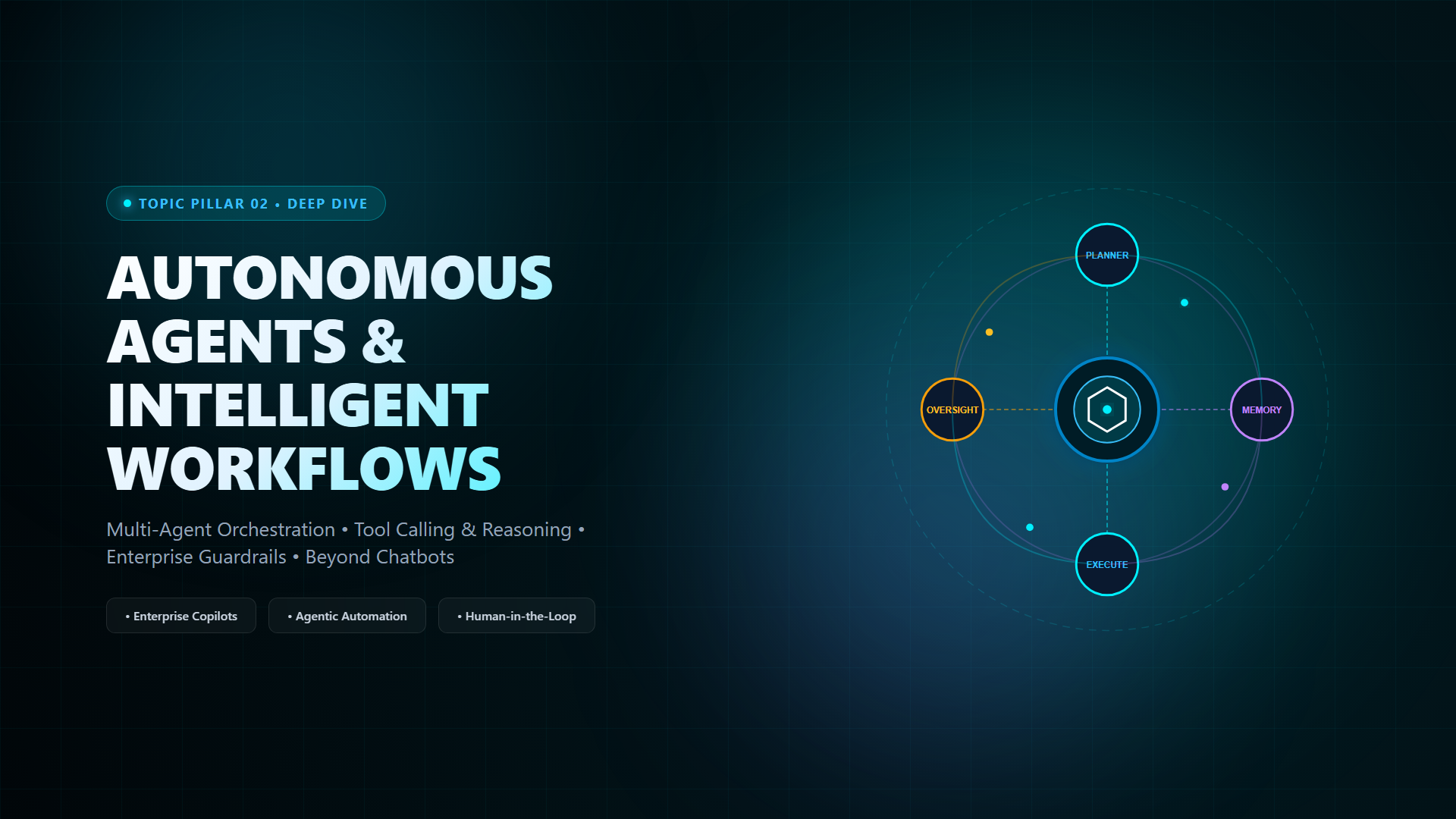
Unlike simple prompt-and-response LLMs, an enterprise agentic system combines four specialized cognitive components:
- Planning & Goal Decomposition: When given a high-level instruction (e.g., "Reconcile disputed vendor invoices for Q3 and draft settlement notices" ), the agent breaks the task into sequential, verifiable sub-tasks.
- Dynamic Memory (Short-Term & Long-Term): Short-term memory tracks in-session context, while long-term memory leverages vector databases and enterprise knowledge graphs to recall organizational rules, historical client interactions, and regulatory constraints.
- Tool Execution (Function Calling): The agent is granted authenticated permissions to interact with enterprise systems—querying core banking ledgers, fetching CRM tickets, issuing SQL queries, or triggering ERP webhooks.
- Self-Correction & Reflection: If a tool returns an error code or an inconsistent data point, the agent analyzes the failure, refines its reasoning, and attempts an alternative resolution path without human prompting.
2. Multi-Agent Orchestration in High-Volume Operations
In mature enterprise architectures, single monolithic agents are quickly replaced by multi-agent swarms , where specialized agents collaborate like a high-performing digital department:
- The Triage / Router Agent: Receives customer or transaction inputs, identifies intent, assesses sentiment and risk tier, and routes the task to specialized sub-agents.
- The Domain Specialist Agent: Executes specific business logic—such as cross-checking insurance policy exclusions against clinical diagnosis codes.
- The Compliance & Verification Agent: Acts as an automated internal auditor, scanning the proposed action against National Privacy Commission (NPC) data rules and internal credit authority limits.
- The Communication Agent: Formulates personalized, empathetic communications in natural English or Taglish, adapting tone according to customer history.
3. Human-in-the-Loop: Setting the Confidence Threshold
Full autonomy without supervision is a catastrophic operational risk. Leading Philippine institutions deploy Supervised Autonomy Frameworks based on dynamic confidence scoring:
If an agent resolves a dispute with a 98% confidence score and a financial exposure under PHP 50,000, it executes autonomously. If the financial exposure exceeds PHP 250,000, or if confidence drops below 85%, the agent drafts the complete package—attaching supporting evidence, policy references, and recommended decisions—and escalates it to a human supervisor for single-click approval.
This hybrid model achieves the ultimate dual objective: it compresses process cycle times by 80% while preserving absolute human accountability.
Experience Agentic AI in Action
GenAI, Agents & Intelligent Workflows is Pillar 02 at World AI Show Philippines 2027 (2–3 March 2027, Manila). Hear from enterprise architects and engineering leaders deploying autonomous multi-agent pipelines across the region.