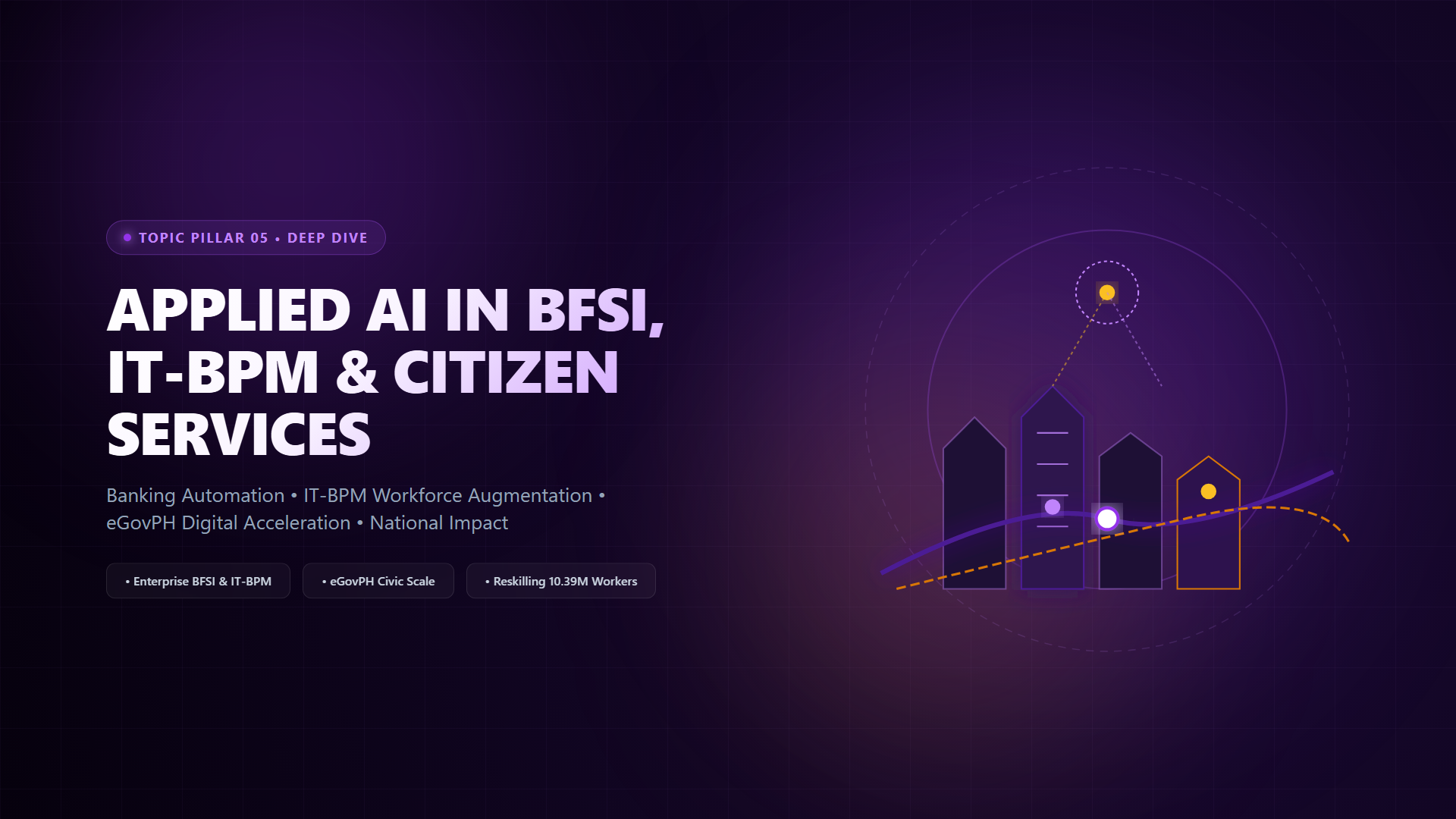
Artificial intelligence in the Philippines is fundamentally a story of operational convergence. While global headlines often obsess over speculative research, the Philippine market is defined by practical, high-impact enterprise and public-sector deployment.
With national policy guided by the National Artificial Intelligence Strategy (approved May 2025) , the DOST Philippine AI Program Framework (running through 2028) , and the AI+ Infrastructure Masterplan 2026–2033 (released September 2026) , public institutions and private industry leaders are executing in synchronized alignment. The goal is clear: leverage artificial intelligence to elevate economic competitiveness, modernize national public administration, and protect the livelihoods of the 10.39 million workers across the digital economy.
This article examines what falls under the Public Sector & Industry pillar—presenting real-world use cases, operational playbooks, and sector-specific transformation blueprints across the country's most critical economic engines.
1. BFSI: The Vanguard of Production AI Deployment
Universal banks and fintech disruptors in the Philippines operate at the cutting edge of domestic AI implementation. Key operational vectors include:
- Algorithmic Inclusion for the Unbanked: Traditional credit scoring requires formal employment records and tax filings—excluding millions of micro-entrepreneurs and gig workers. Leading Philippine institutions utilize machine learning models that analyze alternative data (mobile airtime top-ups, utility bill consistency, e-wallet velocity) to provide automated micro-credit with default rates comparable to prime retail banking.
- Real-Time Behavioral Fraud Interception: As instant digital transfers via InstaPay and PESONet surge, synthetic identity fraud and account takeover attempts have grown exponentially. Graph neural networks analyze millions of real-time transactions, flagging irregular money-mule networks and freezing suspicious transfers in sub-second latency windows.
- Hyper-Personalized Wealth & Insurance Advisory: Multilingual conversational agents guiding retail depositors into tailored retirement, mutual fund, and micro-insurance programs based on lifetime financial behavior.
2. IT-BPM: Scaling Up the Value Chain Through Human+AI Collaboration
The Philippine Information Technology and Business Process Management (IT-BPM) sector is the undisputed crown jewel of the services economy. Rather than succumbing to the narrative of AI displacement, visionary BPO leaders are orchestrating a massive structural elevation from transactional voice handling to high-order analytical partnership:
- Real-Time Agent Augmentation: Customer care representatives are equipped with real-time copilots that listen to calls, automatically retrieve relevant policy knowledge, suggest optimal next-best-actions, and pre-fill CRM documentation—reducing After-Call Work (ACW) by up to 65%.
- Domain-Specialized Knowledge Services: BPO firms are expanding into high-margin complex services—such as clinical medical coding, legal document discovery, financial compliance auditing, and multi-modal AI model evaluation—positioning the Philippines as the global center for governed AI human oversight.
3. Telecommunications & Conglomerates: Optimizing National Infrastructure
The Philippines' leading diversified conglomerates and major telcos are applying AI across physical operations:
- Predictive Cell-Site Maintenance: Utilizing IoT telemetry and machine learning to forecast cellular tower equipment failures and battery degradation before service disruptions impact mobile subscribers.
- Dynamic Energy & Grid Optimization: Power generation conglomerates using predictive algorithms to balance island-grid loads, optimize renewable solar/hydro energy dispatch, and reduce carbon transmission losses across the Philippine grid.
- Retail & Supply-Chain Routing: Optimizing multi-island inter-island shipping and cold-chain logistics, managing unpredictable maritime weather disruptions through automated route recalculation.
4. Public Sector & Citizen Services: The eGovPH Modernization
The Philippine government is proving that public administration can innovate alongside the private sector. The national eGovPH super-app —which logged over 800 million transactions and 56 million downloads by June 2026—launched an AI-powered conversational assistant in September 2026 to streamline citizen interactions.
Public-sector AI adoption is focusing on three high-impact civic domains:
- Streamlined Citizen Permitting & Licensing: Automated document verification for passports, business permits, and land titles, eliminating bureaucratic friction and wait times.
- Disaster Risk Management & Climate Resilience: Predictive modeling analyzing satellite imagery and weather data to coordinate typhoon evacuation, flood mitigation, and relief supply staging.
- Public Healthcare Triage: Assisting rural health units with diagnostic image pre-screening and telemedicine translation, expanding specialist healthcare access across geographically isolated communities.
Convene with the Architects of National Transformation
AI for Industry & Public-Sector Transformation is Pillar 05 at World AI Show Philippines 2027 (2–3 March 2027, Manila). Meet enterprise titans, ministry officials, and technological innovators building real-world scale.