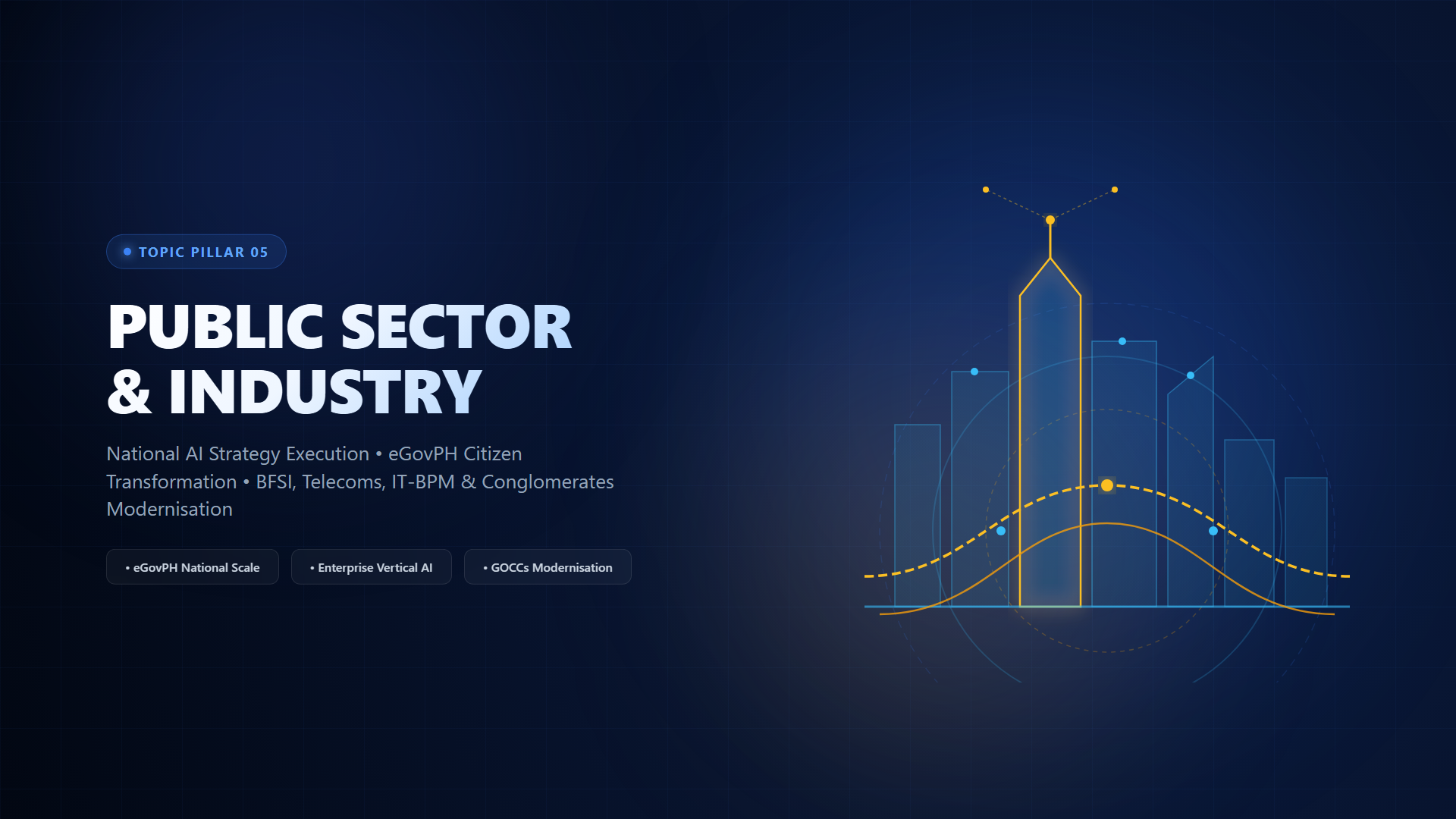
AI in the Philippines is moving from strategy documents into services people use. Government platforms are adding AI features, agencies are building AI skills and industries from banking to manufacturing are applying AI to real operational problems. This article looks at where AI is being put to work, and what it takes to do it well.
The national direction
The National Artificial Intelligence Strategy, approved in May 2025, sets out five focus areas: infrastructure, workforce, innovation, ethics and policy, and deployment. Alongside it, the DOST Philippine AI Program Framework runs through 2028 and explicitly includes AI deployment. Together they place 2026 to 2028 squarely inside an active national implementation window.
Public-sector AI: from policy to citizen services
eGovPH
The national eGovPH platform recorded more than 800 million transactions and 56 million downloads by June 2026, and launched an AI-powered feature in September 2026. It is a clear sign that AI is entering day-to-day citizen services at national scale.
Building AI capability in government
In April 2026, the Development Academy of the Philippines (DAP) launched a national AI capability-building programme for government. Skills are often the deciding factor in whether public-sector AI succeeds, so this investment in people matters as much as investment in platforms.
What makes public-sector AI different
Accountability: decisions affecting citizens must be explainable and open to review.
Trust: privacy and fairness are essential to public confidence.
Scale: services reach millions of people, so reliability is critical.
Procurement: buying AI responsibly requires clear requirements and evaluation criteria.
Industry: where AI is creating value
Banking, financial services and insurance
Fraud detection, credit assessment, customer service, document processing and compliance monitoring, all within BSP expectations for AI risk management.
IT-BPM, GCCs and contact centres
Agent assist, interaction summaries, quality assurance and automation of routine tasks, together with large-scale workforce reskilling.
Telecommunications
Network optimisation, predictive maintenance, churn reduction and personalised customer engagement.
Conglomerates and diversified enterprises
Shared AI platforms and centres of excellence that serve multiple business units, from property and retail to utilities and finance.
Retail, consumer and e-commerce
Demand forecasting, pricing, personalisation and supply chain visibility.
Energy, utilities and manufacturing
Asset monitoring, predictive maintenance, quality inspection and energy efficiency.
Healthcare, transportation and logistics
Administrative automation, patient service, route optimisation and operational planning.
GOCCs: a bridge between government and enterprise
Government-Owned and Controlled Corporations (GOCCs) operate at the intersection of public service and commercial performance. They face many of the same AI questions as large enterprises, from data readiness to vendor selection, together with public-sector expectations on accountability and transparency.
What successful deployments have in common
A clear problem and a measurable outcome
Data and integration foundations in place before scaling
Governance proportionate to risk
Investment in the people who will use and oversee the AI
Strong partnerships between agencies, enterprises and technology providers
Where this conversation continues
AI for Industry & Public-Sector Transformation is a core content pillar at World AI Show Philippines 2027, taking place on 2-3 March 2027 in Manila. Enterprise and government leaders will share applied case studies across banking, IT-BPM, telecommunications, retail, manufacturing, energy, healthcare, public services, and transport and logistics.