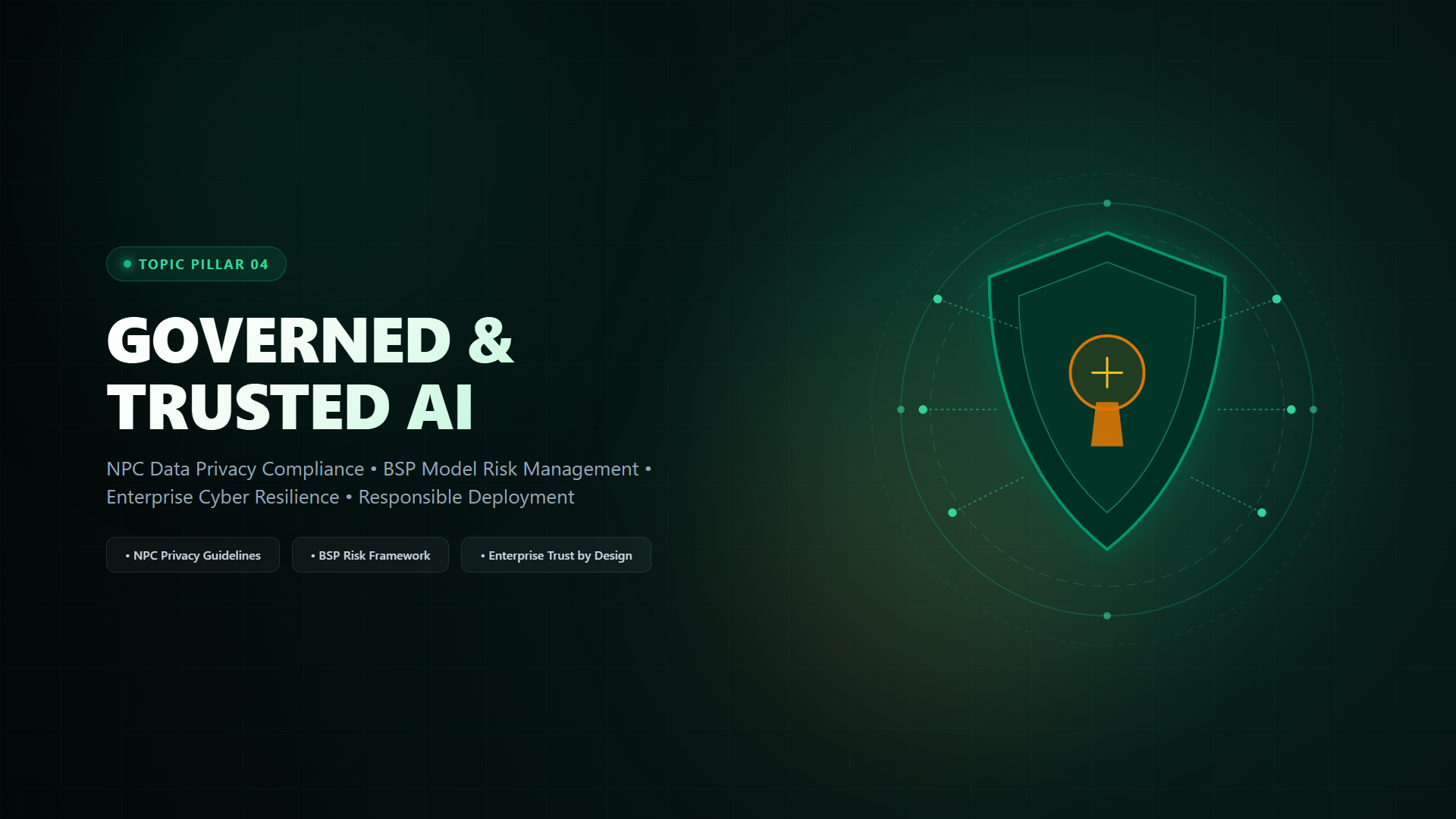
For many Philippine organisations, the question is no longer whether AI can create value. It is whether AI can be trusted to run in front of customers, inside regulated processes and on sensitive data. Governance, privacy and security are often seen as brakes on AI. In practice, they are what allow it to scale.
Governance as an enabler, not a blocker
Without clear rules, AI projects get stuck in endless reviews, or move ahead with risks nobody has assessed. A practical governance framework gives teams a clear path: which use cases are low risk and can move quickly, which need extra controls, and who signs off. That clarity speeds up good projects and stops risky ones early.
The Philippine regulatory picture
Data privacy and the National Privacy Commission (NPC)
The NPC applies the country's data-protection obligations to AI systems that process personal data. Its guidance emphasises transparency, including being clear about the purposes of processing and the parties to whom data may be disclosed. For enterprises, this means privacy needs to be designed into AI systems from the start, not added at the end.
Financial services and the Bangko Sentral ng Pilipinas (BSP)
The BSP has recognised AI-specific risks and expects supervised financial institutions to have AI governance and risk management that is proportionate to how they use AI. For banks, insurers and fintechs, AI models need the same discipline as other material risks: documentation, validation, monitoring and clear accountability.
The security risks unique to AI
AI brings new security questions alongside familiar ones:
Data leakage: sensitive information exposed through prompts, outputs or poorly controlled training data.
Identity and permissions: AI assistants and agents must only see and act on what the user is allowed to.
Prompt injection and manipulation: attempts to trick AI systems into ignoring instructions or revealing information.
Third-party and model risk: understanding how vendors handle data and how external models behave.
A practical AI governance framework
1. Know what AI you have
Keep an inventory of AI systems in use, including tools adopted by business units and features embedded in vendor software.
2. Tier use cases by risk
An internal document summariser and an AI credit decision carry very different risks. Match the level of control to the level of impact.
3. Assign human accountability
Every AI system should have a named business owner responsible for its outcomes, with clear points where people review, approve or override AI decisions.
4. Build privacy and security in by design
Apply data minimisation, access controls, logging and security testing before go-live.
5. Monitor continuously
Track accuracy, fairness, drift, incidents and cost over time, and have a plan for when things go wrong.
Questions boards and leadership teams should ask
Do we know where AI is being used across the organisation today?
Who is accountable for each AI system's decisions and outcomes?
How are we meeting NPC data-privacy obligations in our AI use?
For financial institutions: does our AI risk management meet BSP expectations?
How would we detect and respond to an AI-related incident?
Where this conversation continues
Governed, Secure & Trusted AI is a core content pillar at World AI Show Philippines 2027, taking place on 2-3 March 2027 in Manila. CISOs, risk leaders, data-governance heads and regulators will discuss how to make enterprise AI safe enough to scale.